
Fuel Management for Mining Fleets in Indonesia

Introduction

Mining fleets in Indonesia operate in remote pits, uneven haul roads, and long work cycles. Heavy trucks and excavators run long engine hours, making fuel the highest operating cost for mining companies. With multiple pits and large working areas, operators need a reliable way to monitor fuel usage, refueling patterns, and consumption efficiency.
Challenges

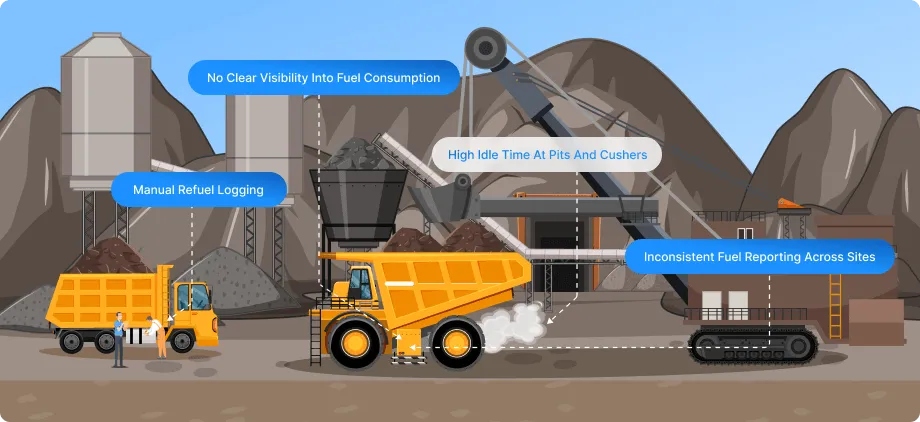
  • No clear visibility into fuel consumption
    Managers cannot track fuel used per shift, per route, or per engine hour.
  • Manual refuel logging
    Refueling at on-site bowsers is recorded on paper, causing mismatch with actual usage.
  • High idle time at pits and crushers
    Vehicles idle during loading/unloading and queueing, increasing fuel burn.
  • Inconsistent fuel reporting across sites
    Different pits use different tracking methods, making it hard to compare performance.
  • Difficulty analysing route-wise fuel efficiency
    Gradients, distance, and pit layout affect fuel usage but remain unmeasured.

Solution with Telematics Software

  • Real-Time Fuel Monitoring
    Track fuel levels, consumption, and usage trends for every mining vehicle.
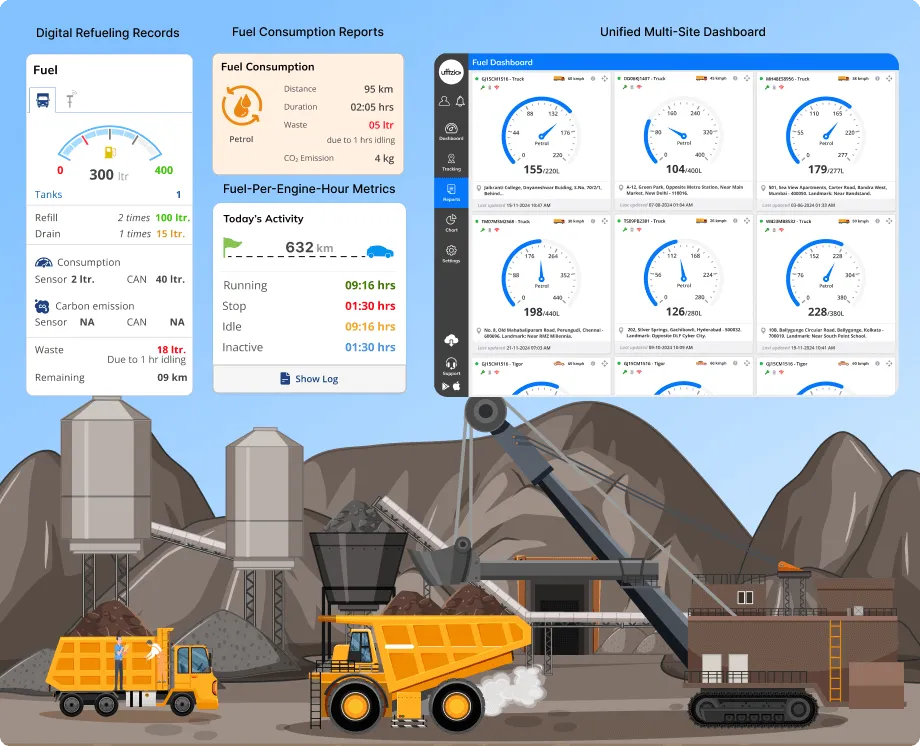
  • Digital Refueling Records
    Each refuel event is logged automatically with before/after tank levels and location.
  • Fuel-per-Engine-Hour Metrics
    Measure fuel usage based on engine hours — the correct benchmark for mining fleets.
  • Idle Fuel Analysis
    Identify idling at pits, crushers, waiting points, and shift-change areas.
  • Fuel consumption reports
    Generate detailed reports of fuel usage across trips, shifts, and operational cycles. 
  • Unified Multi-Site Dashboard
    View standard fuel KPIs across all mining locations in Indonesia.

Results Achieved

  • 8–15% reduction in total fuel consumption
    Better visibility results in more efficient operations.
  • Lower idle-related fuel burn
    Identifying pit/crusher idle zones helps reduce non-productive engine running.
  • Accurate tracking of fuel usage vs refueling
    Each refuel event matches real consumption.
  • Consistent reporting across all sites
    Standardizing fuel KPIs improves decision-making.
  • Improved cost-per-ton performance
    Optimized fuel usage improves hauling efficiency.
  • Better maintenance planning
    Reduced idling and smoother operation protect engine life.

By Uffizio
119 views

Let’s Move Forward, Together

Share your details and we’ll guide you from here.

Let’s Connect!