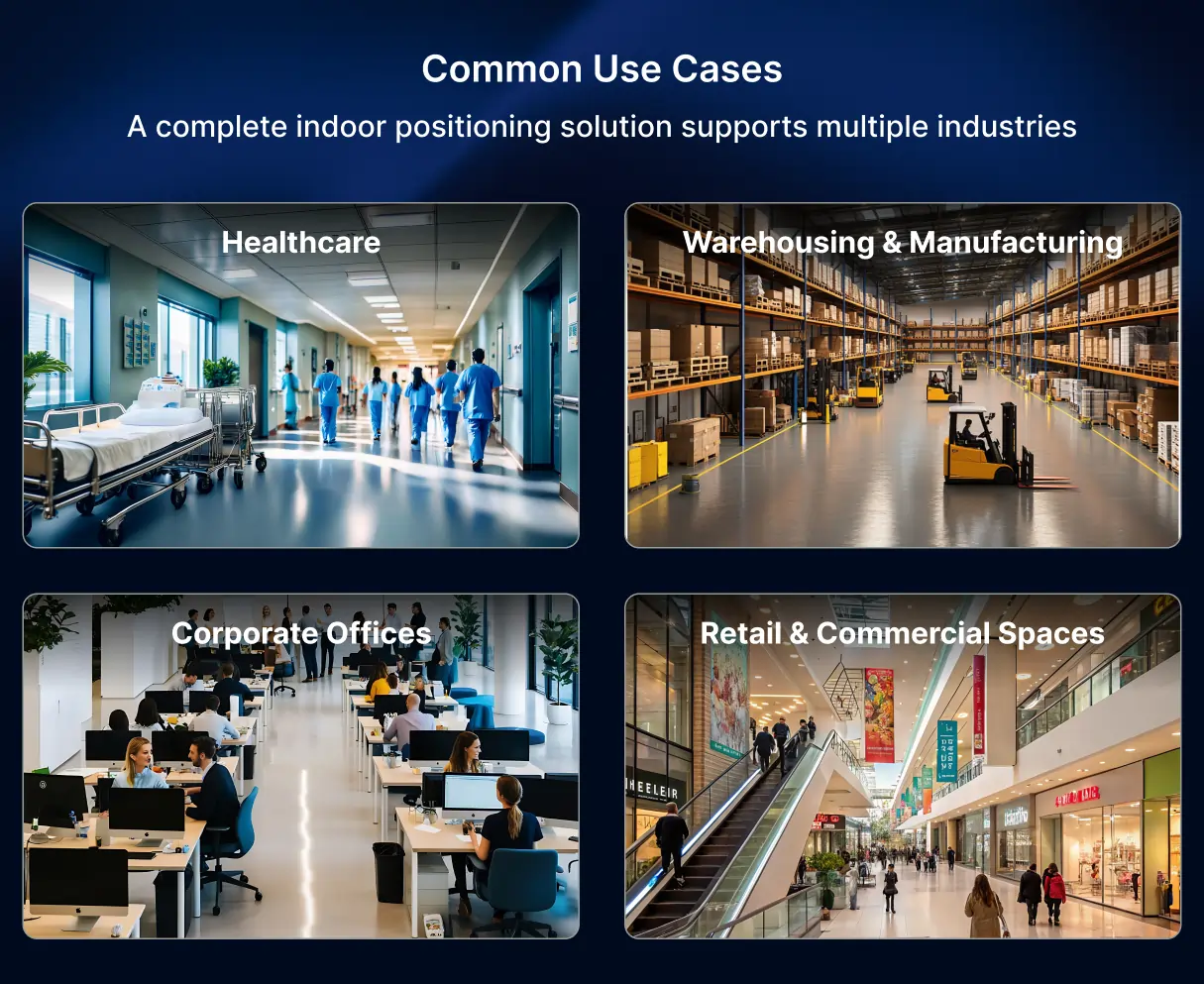
Have you ever wondered why hospitals, warehouses and large facilities fail to track people or assets? The answer is quite simple: managing complex spaces nowadays is not an easy task. In hospitals, staff search for medical equipment during emergencies. In a warehouse, workers move from places to find a misplaced pallet. This is a very common issue faced in large facilities where GPS signals are weak i.e no real time visibility of people or assets. This is why businesses are turning to indoor positioning solutions.
What is an indoor positioning solution?
An indoor positioning solution is a technology that determines location of assets, equipment or people inside the buildings where GPS doesn’t work.This system uses technologies like Bluetooth low energy (BLE), Wifi, Ultra Wideband, RFID or sensors that combine and display location within indoor spaces.
Why businesses need indoor positioning solutions
In an indoor environment, many operations take place throughout the day, with staff working in shifts, asset moves between areas and equipment gets misplaced.
Common operation challenges include :
- Time wasted for searching asset
- Assets underutilised because their location or availability is unclear.
- Unauthorised movement in restricted areas
- Slower response during emergency
- Limited visibility into daily workflow
Understanding BLE indoor positioning system
A BLE indoor positioning system uses bluetooth devices such as beacons or tags that transmit signals. These signals are received by the nearby gateways placed inside the facilities and measure their strength. The tracking software then processes the collected data to identify indoor locations in real-time.
This technology is commonly used because it is cost-effective, consumes less battery power, has a long battery shelf and works realiable in various indoor environment.
Indoor tracking system architecture
A complete solution requires more than hardware, an indoor tracking system architecture, that connects multiple components into one system. Together, they collect the data through signals and convert them into useful indoor location information.
1. BLE beacons and tags
BLE beacons are installed at fixed locations across the building, and BLE tags are attached to assets or carried by people.
They:
- Transmits bluetooth signals continuously
- Act as indoor reference points to understand location
- The device works for a long time and less battery is consumed.
These devices form the important physical foundation of a BLE based RTLS setup helping the system track movement inside the indoor space.
2. Scanning devices (Gateways or Mobile Apps)
Scanning devices detect bluetooth signals from beacons or tags and send the data to the software platform.
These can include:
- Many gateways are installed across floors and departments.
- BLE signals can be detected through mobile applications on smartphones.
Together, they ensure signals are gathered from the indoor facilities.
3. Tracking software
The software is the essential part for any indoor positioning solution and a key component of a real time location system.
- Processes BLE signal data
- Calculates indoor positions
- Tracks movement across rooms and floors
- Stores previous location information
- Generates alerts and notifications
For organizations planning deployment, this layer acts as the foundation of an effective RTLS deployment guide, ensuring the system is reliable, scalable, and business-ready.
4. Indoor maps and navigation layer
Indoor maps play an important role in an indoor positioning solution as it converts signal data into visual location making it easier for users to understand the position of assets or people.
This is where an indoor navigation software platform comes into play.
Indoor maps typically display:
- Floors and rooms
- Zones and departments
- Restricted areas
Live location is visible on these maps, allowing users to understand the movement instantly.
5. Dashboards, analytics, and user interfaces
The final layer is the user-facing experience.
Dashboards provide:
- Real-time indoor tracking
- Search and locate functionality
- Movement history and playback
- Alerts for entry, exit, and dwell time
- Analytics for space and asset utilization
This layer ensures the indoor positioning solution delivers real business value, not just location data.
How indoor positioning solutions works together
In a typical BLE based RTLS setup, the process looks like this:
- BLE beacons and tags transmits signals
- Gateways or mobile apps detect those signals
- Tracking software processes the data
- Indoor locations are calculated and updated
- Results are showcased on indoor maps and dashboards
This continuous flow enables real-time indoor visibility across the organization.

Business benefits for decision-makers
When implemented correctly, indoor positioning delivers measurable ROI.
Key benefits include:
- Reduced asset search time
- Higher resource utilization
- Improved safety compliance
- Faster operational response
- Better space optimization
- Data-driven decision-making
It transforms indoor operations from reactive to proactive.
Final thoughts
A complete indoor positioning solution is not about just installing hardware. It involves BLE devices, tracking software, proper system setup and maps that navigate. This system locates the real-time position of assets, equipment, or people using signal data collected from BLE devices. With this as a solution, indoor tracking becomes smart, reliable and better within updates.