How Fleet Tracking Dashboards Help Managers Make Faster Decisions
You’re managing a busy fleet on a Friday. One driver is stuck in traffic. A vehicle suddenly breaks down. A customer is calling to ask, “Where’s my delivery?” In the middle of all this chaos, you’re expected to manage everything and still make quick decisions — all without having accurate information. This isn’t the real challenge – it’s the moment when updates, alerts and calls come at you at the same time.from all the directions. That’s when it is difficult to make the right decision. Now imagine having all this information on one screen — real-time updates, early breakdown alerts, organized trips, and easy tracking. That’s the power of a fleet tracking dashboard. It gives managers instant visibility and helps them make decisions faster, smoother, and with complete clarity.
Why decision-making is slower without a dashboard
Many fleet teams still depend on traditional methods. Phone calls, spreadsheets, and multiple tools make decision making slow and impossible. When managers have limited visibility, even simple decisions become complicated.
Without a dashboard:
- Managers rely on driver calls for updates.
- Reports indicate what happened hours ago, not what’s happening now.
- Fuel data becomes difficult to verify.
- Route delays go unnoticed until customers complain.
- Maintenance issues appear only after breakdowns.
- Exceptions take too long to detect, increasing costs.
Slow information leads to slow decisions — and in fleet operations, delays always cost money.
What a fleet tracking dashboard actually shows
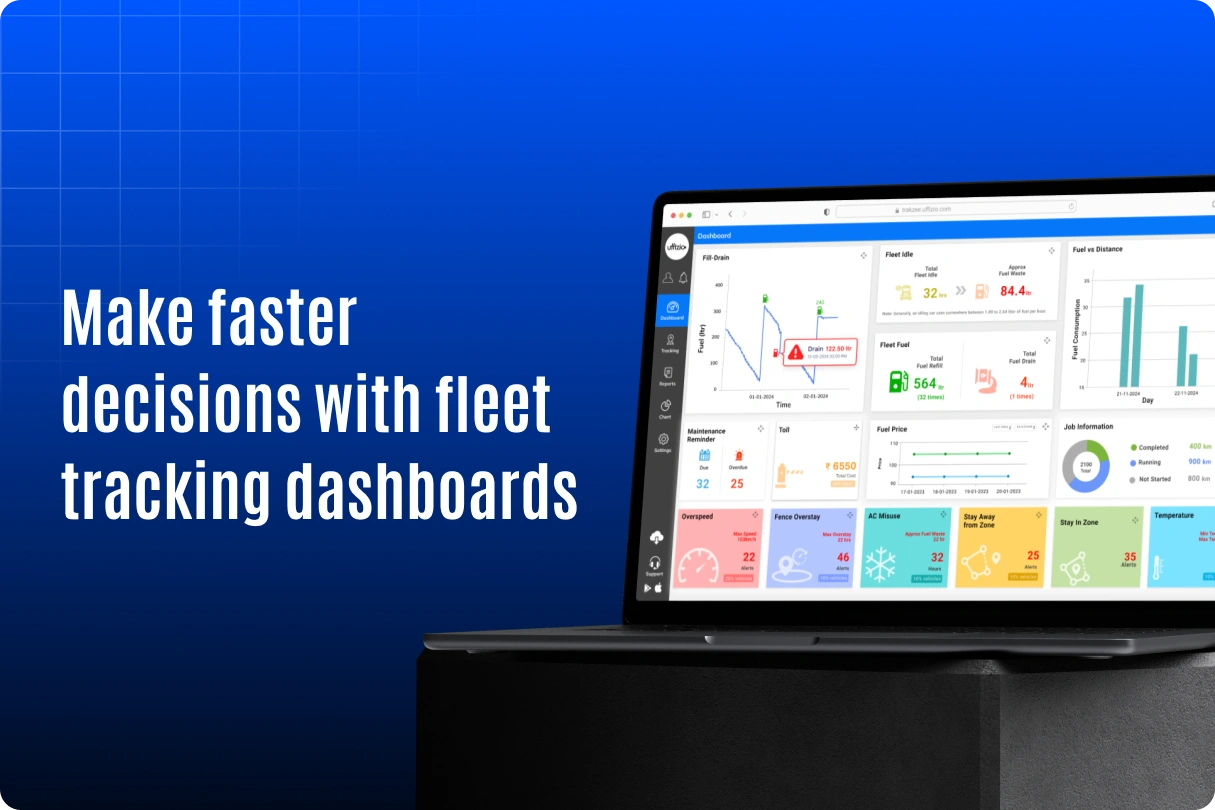
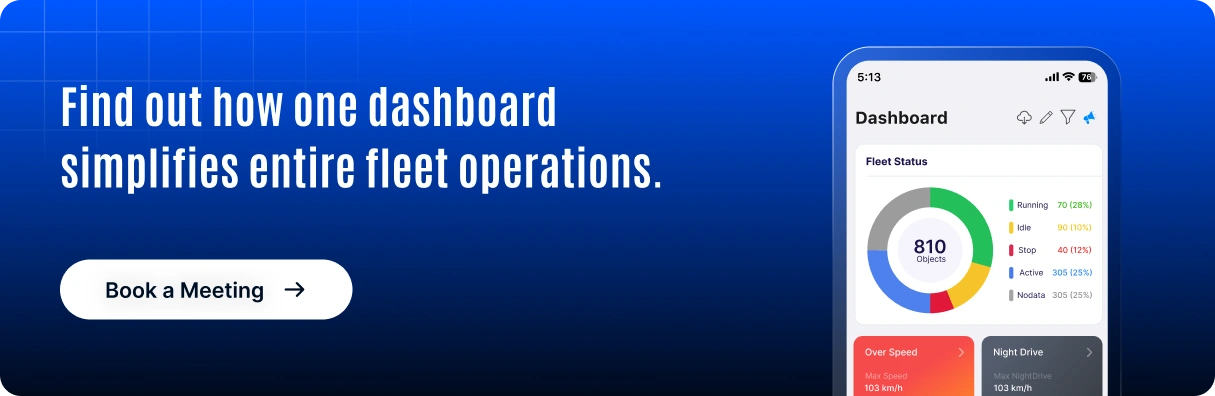
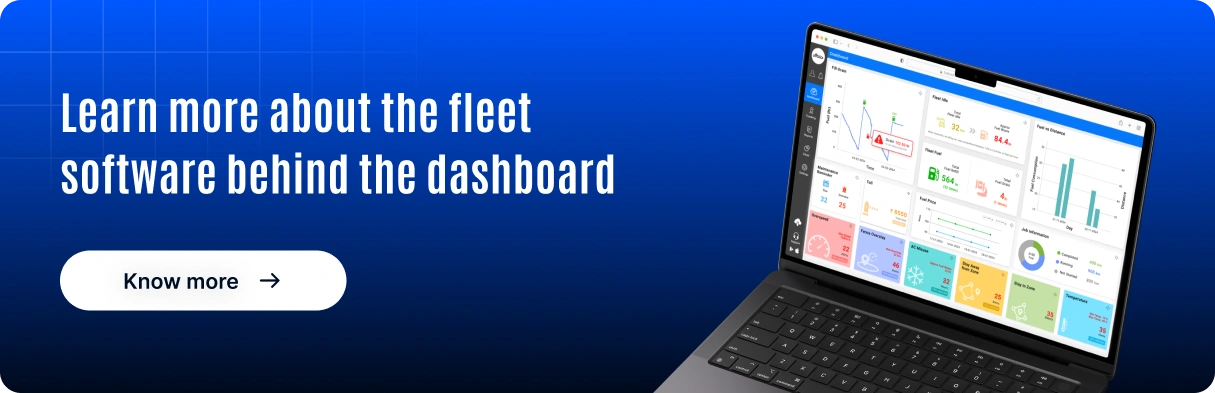
A dashboard brings all performance data into one simple, via screen. Each widget indicates part of fleet activity, giving managers an instant overview.
Live map + vehicle status
Every vehicle appears with its exact location and colour-coded status (Running, Idle, Parked, Offline). Managers know instantly who is behind schedule and who is available.
Trip & activity summary
Distance travelled, idle time, number of stops, and trip duration are displayed clearly. This helps managers evaluate whether routes are being followed and where delays occur.
Fuel consumption insights
Fuel levels, daily consumption patterns, sudden drop incidents, and mileage comparisons help managers identify inefficiencies quickly.
Driver behaviour indicators
Speeding, harsh braking, rapid acceleration, and other events are displayed in real time. Managers can spot risky habits immediately.
Alerts & unexpected events
High-priority alerts — such as route deviation, overspeeding, AC misuse, battery disconnect, or SOS — appear instantly so managers can react fast.
Utilization & productivity metrics
Idle percentages, active hours, and poor utilized vehicles become visible at a glance.
Maintenance & health overview
Upcoming service dates, engine hours, and fault codes help prevent breakdowns before they disrupt operations. This clear, single-screen visibility is what enables fast and confident decision-making.
How fleet tracking dashboard help managers Make faster decisions
Immediate visibility into delays
If a vehicle stops unexpectedly or stays idle too long at a loading point, the dashboard highlights it instantly. Managers don’t need to call the driver — they already know what’s happening and can adjust schedules immediately.
Faster response to driver behaviour risks
When speeding or harsh braking occurs, real-time alerts help managers intervene before an accident happens. This protects drivers, reduces maintenance costs, and strengthens compliance.
Instant fuel anomaly detection
A sudden drop in fuel level could indicate theft or leakage. The dashboard displays the event immediately, enabling managers to verify the incident before more losses occur.
Quick route & job planning adjustments
If traffic builds up on a route, managers can reroute vehicles or assign deliveries to the nearest available driver — all based on the live dashboard view.
Faster maintenance planning
Service reminders and engine alerts allow managers to plan maintenance without disrupting ongoing jobs. This reduces downtime and unexpected breakdowns.
Rapid exception handling
With live alerts, managers can resolve exceptions — such as geofence breaches, unauthorized stops, or battery disconnects — within seconds rather than hours.
Practical scenarios where dashboards save time
Dashboards shine during real operational challenges. Consider these examples:
- A driver takes an unplanned turn → dashboard shows route deviation → manager responds instantly.
- A customer asks for ETA → manager checks live location → provides accurate updates in seconds.
- A priority delivery appears → dashboard identifies nearest available vehicle → job assigned immediately.
- Idle time spikes → dashboard highlights the reason → schedules adjusted before delays grow.
- A fuel drop alert occurs → manager verifies incident on the spot → prevents repeated theft.
- Multi-depot fleets can view all vehicles at once → no confusion between branches.
These real-life scenarios prove how dashboards reduce manual effort and simplify decisions across different fleet types.
Quantifiable Impact on Fleet Efficiency
When dashboards are used consistently, fleets see measurable improvements:
- Significant reduction in idle time
- Lower fuel wastage
- Fewer safety incidents
- Higher vehicle utilization
- More predictable delivery timelines
- Better adherence to planned routes
- Reduced maintenance costs through preventive scheduling
Even small improvements compound across dozens or hundreds of vehicles.
What makes a fleet tracking dashboard truly useful?
A dashboard must be simple, intuitive, and easy to act on. The best dashboards offer:
- Clean, distraction-free layout
- Real-time refresh without delays
- Customizable widgets and KPIs
- Multi-sensor and multi-vehicle support
- Availability on desktop and mobile
- Accurate data processing
- Easy filtering to isolate issues quickly
If the dashboard is cluttered or slow, managers will not use it. Simplicity drives adoption.
How to choose the right dashboard for your business
A good dashboard should not only look good — it must fit your fleet type and workflow.
Consider these factors while choosing:
- Scalability as your fleet grows
- Compatibility with fuel sensors, dashcams, and CANbus
- Easy onboarding for teams
- Ability to configure widgets for your industry
- Strong uptime and reliable performance
- Local and regional compliance support
- Insights for trucks, vans, EVs, machinery, or mixed fleets
Choose a platform that reduces effort, speeds up decisions, and aligns with your long-term business goals.
Conclusion
A fleet tracking dashboard is more than a visual overview — it is a real-time decision-making engine. It equips managers with accurate data, clear alerts, and instant insights that help them act quickly. With a powerful fleet monitoring dashboard, businesses can reduce delays, improve safety, control fuel usage, and operate with greater efficiency. In an industry where speed and clarity matter, a modern dashboard becomes the foundation of smarter fleet operations.